

query generation for agents and apps

Don't let the model
write SQL.

any agent

  • Claude Code
  • Codex
  • Copilot
  • Muse
show emea profit last 30 days
  1. 0sql
    search_fields 3 fields
    profit
  2. 0sql
    plan_query sql · 70 µs
    profit, region = EMEA, date >= 30d
0sql

generated sql

SELECT sum(T0.profit) AS "Profit"
FROM sales T0 LEFT JOIN region T1 ON T1.id = T0.region_id
WHERE T1.name = 'EMEA' AND T0.date >= current_date - 30
The agent types "show emea profit last 30 days", calls 0sql's search_fields tool to find the measure, then plan_query with a spec in business terms, and receives one SQL statement planned against the governed model.

Planned against your governed model, never your warehouse. Same spec, same statement, every time.

request
curl -s https://app.0sql.io/projects/tpcds/branches/main/sql \
  -H "Authorization: Bearer zqk_…" \
  -H "Content-Type: application/json" \
  -d '{
    "spec": {
      "projections": [
        {"field": "Web Net Paid"},
        {"field": "Web Sold Date"},
        {"field": "Net Paid"}
      ]
    }
  }'
shorthand
zsql sql --expr "web net paid, web sold date, net paid"
request.js
const res = await fetch('https://app.0sql.io/projects/tpcds/branches/main/sql', {
  method: 'POST',
  headers: { Authorization: `Bearer ${key}`, 'Content-Type': 'application/json' },
  body: JSON.stringify({
    spec: { projections: [{ field: 'Web Net Paid' }, { field: 'Web Sold Date' }, { field: 'Net Paid' }] },
  }),
});
const { sql } = await res.json();
response sql, adapter postgres, planned in 70 µs
response.sql
WITH ag29130fae5cf6548d6ddb1bd37298b407 AS (
SELECT
	sum(T0."ws_net_paid") AS "msr501e4a8",
	T0."ws_sold_date_sk" AS "dimed56b67"
FROM
	web_sales T0
GROUP BY
	T0."ws_sold_date_sk"
), ag7098b0d0901f2eb16d14f9356f0bb2a0 AS (
SELECT
	T0."ss_sold_date_sk" AS "dimed56b67",
	sum(T0."ss_net_paid") AS "msr621f67c"
FROM
	store_sales T0
GROUP BY
	T0."ss_sold_date_sk"
)
SELECT
	A0.msr501e4a8 AS "Web Net Paid",
	COALESCE(A1.dimed56b67, A0.dimed56b67) AS "Web Sold Date",
	A1.msr621f67c AS "Net Paid"
FROM
	ag29130fae5cf6548d6ddb1bd37298b407 A0
	FULL OUTER JOIN ag7098b0d0901f2eb16d14f9356f0bb2a0 A1
		ON A1.dimed56b67 = A0.dimed56b67

Two measures from two fact tables, one conformed date. Each fact is aggregated at its own grain and stitched with a full outer join. Nothing double counts, and nobody modeled that query.

trusted by data teams at

  • Lumen Freight
  • ORBITAL
  • hatchline
  • Kestrel Health
  • VANTAGE
  • Meridian Labs

head to head

0sql vs LLM-to-SQL vs other semantic layers

One difference of many. A median order value needs two levels of aggregation: sum each order, then take the median. Only one of the three answers it correctly, with your security policy already in the statement, without touching your data.

See every difference in the comparison table
median order value by region

LLM-to-SQL

The model writes the SQL itself.

what it wrote

SELECT r.name AS region,
       median(s.net_paid) AS median_order
FROM sales s JOIN region r ON r.id = s.region_id
GROUP BY r.name

median(s.net_paid) is the median of line items, not of orders. Fluent, plausible, wrong. And no row-level security.
wrong answer EMEA 38.20

Other semantic layers

Governed, but one aggregation per measure.

what it returned

measure median_order_value

aggregation median(net_paid)

not expressible

A measure aggregates once. There is no grain between the row and the result, so a median of per-order sums cannot be defined.

Safe, because it refuses. Useless, because it refuses the right question.

no answer
0sql

0sql

Plans the statement from your model. Never runs it.

what it returned

spec region, median order size

SELECT A0.region,
       percentile_cont(0.5)
         WITHIN GROUP (ORDER BY A0.order_total)
FROM (
  SELECT T1.name AS region, T0.ticket,
         sum(T0.net_paid) AS order_total
  FROM sales T0
  JOIN region T1 ON T1.id = T0.region_id
  WHERE T1.name IN ('EMEA', 'APAC')
    -- the caller's row-level security
  GROUP BY T1.name, T0.ticket
) A0
GROUP BY A0.region

The measure is modeled once as an inclusion: sum per ticket, then the median. The request is two field names. The security context is already in the statement.

correct secured · 70 µs EMEA 412.80

A plausible wrong number ships. A refusal ships nothing. 0sql ships the statement, and you can read it before it runs. Reference: inclusion measures.

example · open source

Build a custom agentic dashboard using 0sql only for query generation.

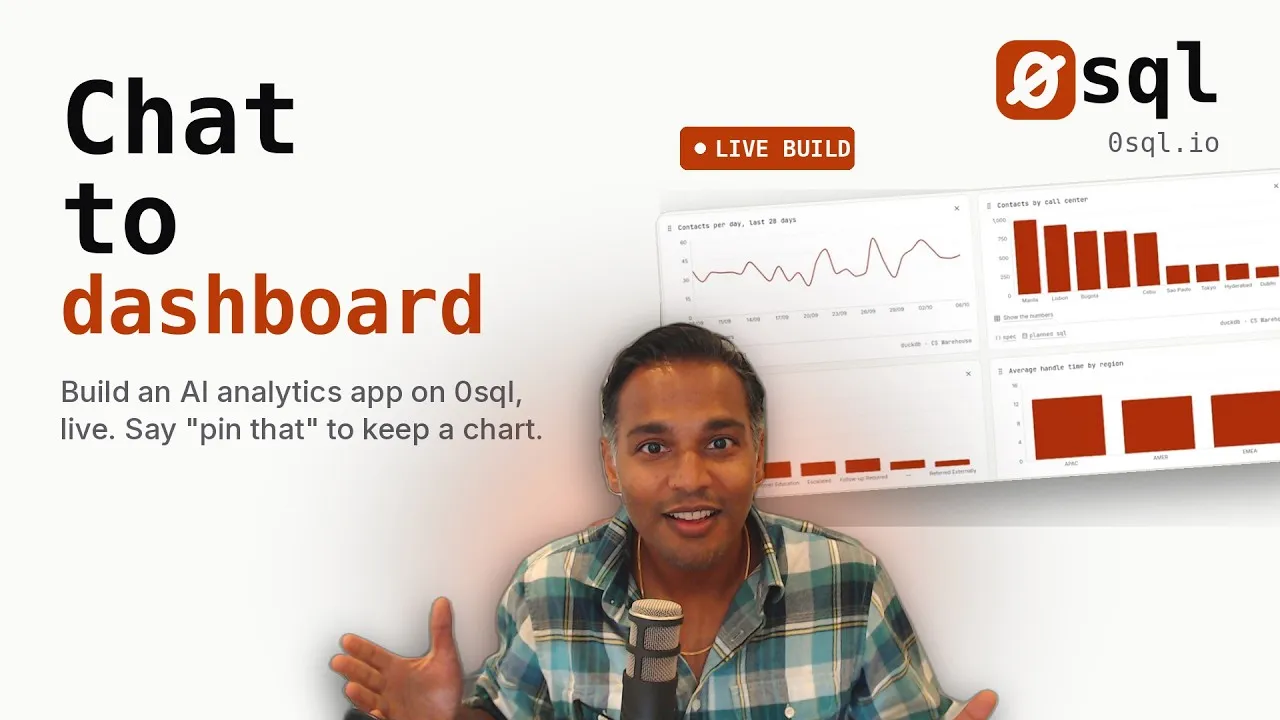
Your dashboard is a chat. A question goes in, the agent writes a 0sql spec, 0sql returns the SQL, your app runs it on your warehouse and draws the chart. Say “pin that” and it is a tile.

The demo app, mid-conversation. Left: the question, the agent's trace, the chart it drew. Right: the dashboard tiles. Open it full size to read the trace.

one turn, under the hood

> Which call centers have the longest average handle time?
the agent writes a spec, never SQL
spec
{
  "projections": [
    { "field": "Call Center" },
    { "field": "Average Contact Duration Secs",
      "alias": "Average Handle Time Secs", "order_by": "desc" }
  ]
}
0sql plans it against the deployed model
planned.sql
SELECT
	T1."call_center_desc" AS "Call Center",
	sum(T0."contact_duration_secs") * 1.0 / nullif(count(*), 0) AS "Average Handle Time Secs"
FROM
	cs_contact_f T0
	LEFT JOIN cs_call_center_d T1
		ON T0.call_center_id = T1.call_center_id
GROUP BY
	T1."call_center_desc"
ORDER BY
	sum(T0."contact_duration_secs") * 1.0 / nullif(count(*), 0) desc

The join came from the model and the average is the measure's own formula, because an average of an average is a bug and that gets settled once, in the YAML, not in every question.

[ø] chat dashboard demo
The chat dashboard demo. On the left, the question “Which call centers have the longest average handle time?”, the agent's trace, the bar chart it produced and its written answer. On the right, pinned dashboard tiles: contacts per day, contacts by call center, resolution mix, average handle time by region.

Model. Deploy. Request. Run.

Four steps, three of them yours. The semantic model is YAML in git; a branch deploys as a branch.

  1. 01

    model

    Tables, fields and joins in YAML

    Name a measure once. Declare joins with cardinality. The planner derives every reachable combination; you never write a query.

    models/sales/tbl.web_sales.yml
    name: Web Sales
    physical_name: web_sales
    datasource: warehouse
    cost: 100
    
    fields:
      - type: measure
        name: Web Net Paid
        data_type: decimal
        expression:
          sql: sum(ws_net_paid)
    models/sales/rel.sales.yml
    datasource: warehouse
    
    web_sales_item:
      left: Web Sales
      right: Item
      sql: left.ws_item_sk = right.i_item_sk
      cardinality: many_to_one
  2. 02

    deploy

    One command, per git branch

    Secrets are stripped before upload. The service validates the model, forms the universes, runs your tests and answers with counts and warnings.

    terminal
    $ zsql deploy
    deploy tpcds (6120 bytes) as tpcds/main (the production branch) to https://app.0sql.io
    deployed tpcds/main: 6 tables, 41 fields, 7 joins, 11 paths, 1 policies
    PASSED  category by net paid
    tests: 1 passed, 0 failed
  3. 03

    request

    A spec, or one line of shorthand

    Decorators for month grains and period-over-period, filters that land in WHERE or HAVING by themselves.

    POST /projects/tpcds/branches/main/sql
    {
      "spec": {
        "projections": [
          {"field": "Date", "decorators": [{"type": "truncate", "grain": "month"}], "order_by": "asc"},
          {"field": "Web Net Paid", "decorators": [{"type": "temporalize", "transform": "month_over_month"}]}
        ],
        "filters": [{"field": "Web Net Paid", "predicate": "greater_than", "value": "100"}]
      }
    }

    the same, as shorthand: zsql sql --expr "month(date) asc, mom(web net paid), web net paid > 100"

  4. 04

    run

    In your code, on your warehouse

    Top five categories by revenue: a ranking CTE joined back, no window-function guesswork. Hand it to your driver.

    response.sql
    WITH ag5c9bb8d550197b3a219ae50f0b427905 AS (
    SELECT
    	T1."i_category" AS "dim30d09b7",
    	sum(T0."ws_net_paid") AS "msr0c0d023"
    FROM
    	web_sales T0
    	JOIN item T1
    		ON T0.ws_item_sk = T1.i_item_sk
    GROUP BY
    	T1."i_category"
    ORDER BY
    	sum(T0."ws_net_paid") desc
    LIMIT 5
    )
    SELECT
    	sum(T0."ws_net_paid") AS "Web Net Paid",
    	T1."i_category" AS "Category"
    FROM
    	web_sales T0
    	JOIN item T1
    		ON T0.ws_item_sk = T1.i_item_sk
    	INNER JOIN ag5c9bb8d550197b3a219ae50f0b427905 AS A2
    		ON T1."i_category" = A2.dim30d09b7
    GROUP BY
    	T1."i_category"

security

Your data never leaves your network.

0sql holds the shape of your warehouse, never its contents. A spec goes out, a statement comes back, and it runs inside your own perimeter with the caller's policy already in it.

your network

  • your application
  • your warehouse
  • rows and results
  • your credentials
spec + context sql

0sql 0sql

  • your semantic model
  • the planner
  • no connection
  • never a connection
  • never a row
  • never a result
  • never a cache

Specs and contexts are planned in memory, never stored or logged. What is kept.

row-level security, compiled into the statement

country tank@matrix.com CC-TMNT, CC-AVCL
0sql
policy call_center_id fired on the caller's groups
CC-TMNT → call_center_id:TMNT · CC-AVCL → call_center_id:AVCL
0sql

generated sql

SELECT
	T0."cc_country" AS "Country"
FROM
	call_center T0
WHERE
	LOWER(T0."cc_call_center_id") IN ('tmnt', 'avcl')

The WHERE came from the context, not from the prompt. Rows the caller may not see are never read.

The context comes from your auth system with every request. A branch with policies refuses to plan without one.

determinism

Same spec, same SQL. Byte for byte.

On every deploy and every replica. Join routes and merge order are settled by name, never by row id, so planning is not a coin flip.

Pin a statement in a test. A model edit that would change the SQL your application depends on fails the deploy instead of surprising you in production.

The planner is held to byte-for-byte parity with the engine inside Strata, which has run at Netflix scale for years.

tests/revenue_by_category.yml
name: revenue by category
projections:
  - Category
  - Net Paid
assert_sql: |
  SELECT
  	T1."i_category" AS "Category",
  	sum(T0."ss_net_paid") AS "Net Paid"
  FROM
  	store_sales T0
  	JOIN item T1
  		ON T0.ss_item_sk = T1.i_item_sk
  GROUP BY
  	T1."i_category"
runs on every deploy
terminal
$ zsql deploy
deploy tpcds (6120 bytes) as tpcds/main (the production branch) to https://app.0sql.io
deployed tpcds/main: 6 tables, 41 fields, 7 joins, 11 paths, 1 policies
PASSED  category by net paid
tests: 1 passed, 0 failed

reliability

Refusals, not wrong numbers.

A measure asked for by a dimension its fact cannot reach is an error with a class and a message, never a fan-out. A hallucinated field is a 422, not a confident wrong answer.

Misspelled fields resolve by similarity when one clearly leads, and the response says so under corrections.

/explain
The node tree, join routes and microsecond timings behind a statement.
/explore
What a query can still add and stay resolvable.
/fields
Fields by name, synonym or similarity, for pickers and agents.
> Web Net Paid by Store Name
web sales never happened in a store, so there is no join to find
422 Unprocessable Content
{
  "error": {
    "class": "Unresolvable",
    "message": "Could not find Universe for measure: Web Net Paid, id: 376"
  }
}

Every error class is documented, so an agent can read the message and fix the spec on its next turn. Error classes.

compared · semantic layer as a service

Everything a semantic layer should do. Nothing it should not.

0sql is a semantic layer as a service: the model, the planner and the API, without the server, the cache or the warehouse connection. Side by side with Cube and MetricFlow, from their own documentation. Every 0sql cell links to the docs page that shows the SQL.

Querying and modeling
Querying and modeling 0sql Cube MetricFlow
Automatic data blending across many domains Measures from many facts in one statement. No fan-out. Primary keys and views; many-to-many needs an associative cube. Full outer join across facts. Two hops at most.
Standard aggregates Any SQL aggregate. A fixed list of aggregation types. Simple metrics over one column expression.
Compound measures across facts Formulas over measures from different facts, auto-leveled. Number measures inside one cube or view. Derived metrics.
Snapshot measures Beginning or ending balance per period. — —
Exclusion level of detail Percent of total and fixed denominators, in the model. Multi-stage measures. —
Inclusion level of detail Aggregate per entity first, then re-aggregate. Multi-stage measures. —
Ratios A compound measure, or a formula in the request. Number measures. Ratio metrics.
Running and moving windows A decorator in the request. Rolling-window measures, modeled. Cumulative metrics, modeled.
Period over period A decorator in the request. Time-shift measures, modeled. offset_window on a derived metric, modeled.
Top-n and ranking A filter in the request. Rank, as a multi-stage measure. —
Conversion between events Cohort conversion through segments. No per-event window. — Conversion metrics.
Formulas in the request [Measure]@m over any measures. No deploy. Modeled first. Modeled first.
Cohort beside baseline A segment on one measure or the query, with exclude mode. Segments filter the whole query. Per-metric filter in a derived metric.
Partition-aware routing Routes to the table whose partition holds the data. Partitions its own pre-aggregations only. —
Routing across compute engines A hot engine for the partitions it holds, colder ones for the rest. — —
Aggregate-aware routing The cheapest table you already own: tiers, costs, aggregates. Pre-aggregations copied into Cube's own separate store. —
Row-level security and masks Policies become WHERE or CASE masks. No context, no plan. Access policies from a JWT context. Not in the layer. Warehouse grants.
Pinned SQL, tested on deploy assert_sql fails the deploy. — —
Built for agents /explore, /fields, typed errors, llms.txt. Meta API. Chat APIs in Cube Cloud. dbt MCP server.
Architecture
Architecture 0sql Cube MetricFlow
What comes back SQL. Nothing executes. Rows. SQL from /v1/sql, for debugging. Rows. --compile shows the SQL.
Needs your warehouse credentials No. It never connects. Yes. Yes, through dbt.
Holds results or a cache No. Planned in memory, never stored. Relational cache and pre-aggregations. Exports materialize saved queries.
Warehouses 13 dialects. 35+ data sources. 6 platforms.
How you get it Hosted API. Free today. Apache 2.0 core, or Cube Cloud. Apache 2.0 engine. APIs need dbt Cloud.

Read from each project's public documentation on 6 October 2026. A dash means no documented equivalent was found. Cube and MetricFlow are trademarks of their owners. Spotted a mistake? Tell us and we will fix it.

One model, thirteen dialects

The adapter on the datasource decides quoting, date functions, join support and CTE strategy. Hot and cold tiers, partitions and aggregate tables route each request to the cheapest table that can answer it.

plan time
~70 µs
per request, release build
warehouses
13
one model, one request, every dialect
rows we can see
0
no connection, no credentials, no logs, no cache
measure kinds
5
standard, compound, snapshot, inclusion, exclusion

Need the whole stack?

0sql is the layer. Strata is the platform.

0sql returns SQL and stops there, because you are building the product around it. If what you want is the product, Strata is the same planner with everything else already attached: query execution across federated engines, aggregate awareness and hot tiers, dashboards that are good by default, self-service for non-technical users, and delivery through exports, subscriptions and Google Sheets.

It is also where the agents already live. Strata ships AI analytics over the same governed model, so a non-technical user or an agent can ask broad, cross-domain questions and get answers that are correct by construction, without you writing the retrieval layer, the chart layer or the guardrails.

The model format is the same one, so this is not a decision you have to get right today. A semantic model you write for 0sql is a semantic model Strata can run.

Stop generating SQL. Start declaring it.

Get a key, install zsql, model three tables, deploy, send your first spec. The quickstart walks through every step with the SQL that comes back.

Early access, everything included. What that means.